5 Signs of AI Readiness Gap in Business
Artificial Intelligence, Business Strategy, Data Readiness
5 Signs Your Business Has an AI Readiness Gap (And What To Do About It)
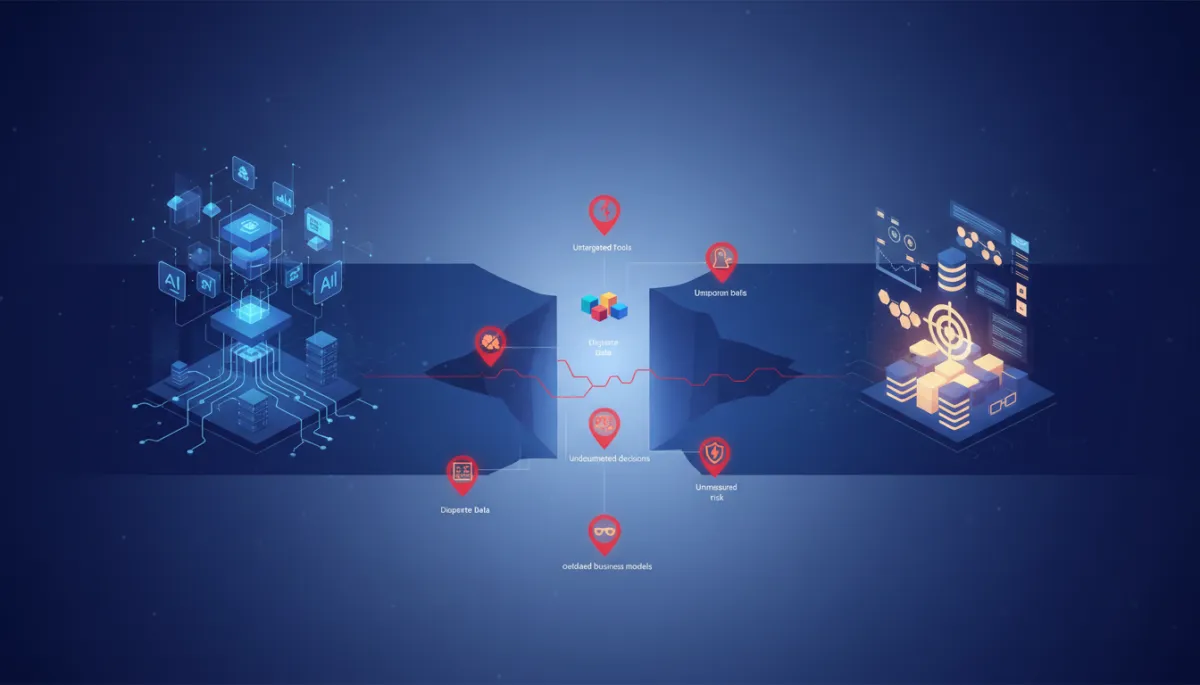
Buying AI tools isn’t the same as being ready for them. As adoption accelerates—McKinsey estimates 88% of organizations now use AI in at least one business function—many leaders are discovering a quieter problem: their foundations aren’t ready to turn that usage into measurable results. An AI readiness gap isn’t about whether you have tools; it’s about whether clean data, clear processes, and defined commercial targets sit underneath them. Without that, AI simply gives you faster chaos, not better decisions. Here are five practical signs that gap exists in your business, and what to do about each one.
1. You’ve adopted AI tools, but can’t point to what they’ve changed
If you’re paying for two or three AI subscriptions and, when asked, can’t name a specific number that has moved because of them—hours saved, leads converted, costs cut—that’s the clearest sign of an AI readiness gap. Tools were adopted before a target was set. It’s a common pattern: Deloitte finds 60% of workers now have access to sanctioned AI tools, but only 34% of companies say AI is deeply transforming the business. The rest are stuck in “tools without outcomes” territory.
The irony is that AI can be highly effective for small and mid-sized businesses when it’s applied to named problems. Research from the U.S. Chamber of Commerce Foundation shows that most small businesses using AI report efficiency and revenue gains, with benefits clustering around businesses that deployed AI against specific use cases rather than as a vague “upgrade.” In other words, impact follows clarity, not enthusiasm.
How to close this gap
Pick one commercial metric that matters this quarter—time-to-quote, response rate, cost per lead, average order value—and work backwards. Ask, “Where exactly is this number getting stuck?” Then match an AI application to that choke point: drafting first-pass proposals, prioritising inbound leads, summarising customer feedback, or generating campaign variations. Only after you can point to a moved metric should you add another AI use case or tool.
2. Your data lives in five places and agrees with none of them
AI is only as useful as what it’s reading. If your CRM, bookkeeping software, website analytics, and team spreadsheets all tell a slightly different story about the same customer—or even the same month’s revenue—no AI layered on top will resolve that. It will just generate confident-sounding answers from inconsistent inputs, and you’ll spend more time reconciling than deciding.
This is the single biggest readiness bottleneck leaders report. Dun & Bradstreet found that while 97% of organisations have active AI initiatives, only 5% feel their data is truly ready to support them. Accenture similarly notes that just 7% of businesses have built genuinely AI-ready data capabilities, yet those “data reinventors” enjoy profit margins up to 1.6× higher than peers. The message is blunt: data consistency is not a nice-to-have; it’s the multiplier.
How to close this gap
Start with an audit, not an integration project. List your core numbers: revenue, active customers, leads, pipeline value, support tickets, inventory. For each, answer two questions:
Where does this number live today?
Which system should be the source of truth for it?
Then clean up before you automate. Align field names, remove duplicates, and lock in simple rules (for example, “the CRM is the truth for customer status; finance is the truth for revenue”). Only once that’s in place should you plug AI into reports, forecasting, or personalised campaigns. Otherwise, you’re just scaling the confusion you already have.
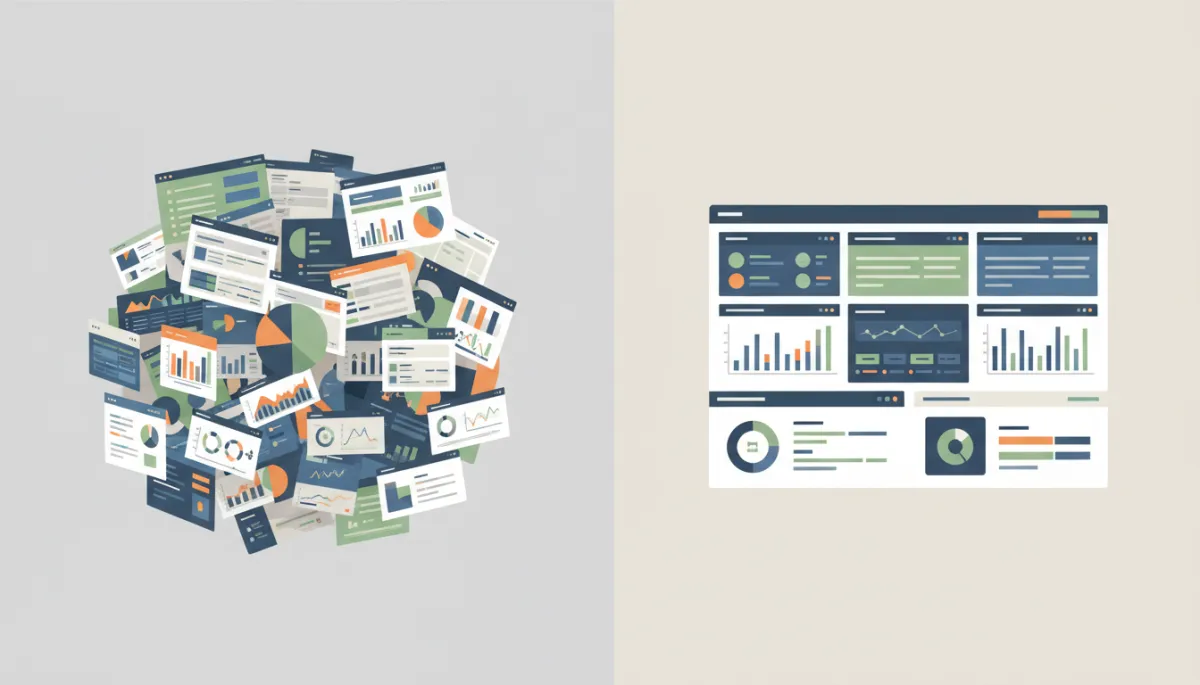
When data is unified first, AI turns from noisy guesses into reliable guidance.
3. Decisions still happen in someone’s head, not in the system
If pricing, stock reordering, discount approval, or lead prioritisation depends on one person’s judgement and isn’t written down anywhere, AI can’t learn it, replicate it, or improve it. In many founder-led businesses, the owner is effectively the entire business intelligence function. That works—until it doesn’t. It becomes a bottleneck, and it’s a hidden readiness gap AI can’t fix on its own.
Globally, the skills and process gap is now cited as a bigger barrier than the technology itself. The World Economic Forum’s recent research found that 63% of employers point to the skills gap—not access to AI tools—as the primary obstacle to AI transformation. Deloitte echoes this: only about a third of leaders are using AI to truly reimagine how decisions are made; the rest are layering tools on top of unchanged habits.
How to close this gap
Choose the two or three decisions that currently only you know how to make. For each, write a one-page “playbook” that explains:
What information you look at (for example, deal size, lead source, stock level).
The rules or thresholds you use (“If margin is under 20%, don’t discount.”).
The exceptions where you override the rule.
That document becomes the brief for where AI can genuinely take weight off your plate—whether that’s a simple rules engine, a recommendation model, or a copilot that drafts suggested actions for you to approve. You’re not handing the business to a black box; you’re codifying your judgement so AI can support it at scale.
4. You’re excited about AI but no one’s measured the risk
Faster decisions and automated processes are only a win if they’re not quietly introducing new risk—data you shouldn’t be storing, compliance you’re not meeting, or a customer-facing chatbot that occasionally invents an answer. As agentic and autonomous AI grows, governance is lagging badly: Deloitte reports that only about 21% of organisations using advanced AI have mature governance models in place, and Okta finds just 10% have clear strategies for governing non-human identities such as AI agents and service accounts.
If that conversation hasn’t happened yet in your business, the readiness gap isn’t in your tools; it’s in your governance. A genuine AI readiness assessment weighs risk reduction just as seriously as it weighs growth. In 2026, regulators, customers, and partners are all asking sharper questions about how data is used, stored, and protected. “Move fast and break things” is no longer a safe operating model.
How to close this gap
Treat “reduce risk” as a named commercial outcome, not an afterthought. Start by mapping where AI touches:
Customer data (for example, chat transcripts, support tickets, sales notes).
Financial or operational data (pricing, payroll, contracts).
Public-facing content (chatbots, automated emails, website copy).
For each, ask: “What’s the worst realistic failure here, and how would we spot it?” Then put simple controls in place—human review for sensitive outputs, clear data retention rules, access controls for AI tools, and a named owner for AI risk. This doesn’t have to be heavy-weight compliance; it just has to be deliberate.
5. You’ve never had the business scored against where it actually needs to be
This is the gap underneath all the others. Most owners are making AI decisions against a mental model of their business that’s a year or two out of date. Systems have changed, the team has grown, customers have shifted, and yet AI decisions are still being made on “how things used to be.” Without a current, structured read—across systems, data, marketing, operations, and risk—every AI purchase is a guess dressed up as a strategy.
The broader data backs this up. IDC’s AI MaturityScape Benchmark shows that while AI ambition is everywhere, more than 60% of organisations sit in the two lowest maturity stages. AIOpsNav’s benchmark for professional services firms puts median AI readiness at just 34/100, well below the threshold needed to scale. In other words, most businesses are experimenting with AI on foundations that haven’t been properly inspected.
How to close this gap
Get an outside, structured read of where the business stands today—before the next tool purchase, not after. That means scoring your business across the areas that actually determine AI payoff:
Systems and data foundations.
Marketing and customer journey visibility.
Operational processes and decision-making.
Team skills and adoption readiness.
Risk, governance, and compliance.
A structured assessment turns vague worries (“We’re behind on AI”) into a concrete roadmap (“We’re strong on tools, weak on data, missing governance, and need to document three core decisions”). It’s the difference between buying more software and building a business that’s genuinely futureproof.
The takeaway: Fix the sequence, not the ambition
None of these five signs mean AI is the wrong move for your business. They mean the sequence is wrong—tools before diagnosis, enthusiasm before foundation. In 2026, AI adoption is nearly universal, but maturity is not. Businesses that pause to align data, processes, decision-making, and risk before scaling AI are the ones seeing durable gains in productivity, revenue, and resilience.
Fix the sequence and the same AI spend goes considerably further. You move from scattered experiments to a clear, commercial story: here’s what we’re trying to change, here’s how AI helps, and here’s how we know it’s working.
📌 Key Takeaway: AI tools amplify whatever foundation they sit on. Invest first in clean data, documented decisions, and risk-aware governance, and AI becomes a force multiplier instead of an expensive distraction.
Get your Business Intelligence Score
Want the honest version of where your business stands on AI readiness? Take the free Futureproof Check and get your Business Intelligence Score across the ten areas and five commercial outcomes that actually determine whether AI pays off—growth, efficiency, resilience, risk, and customer experience. It’s a practical, no-jargon way to see where the real gaps are before you commit to the next tool.
